Match Masters
- 4.8
- Rating
- 50.00M
- Installs
- Free
- Price

 Analysis by App-foxy
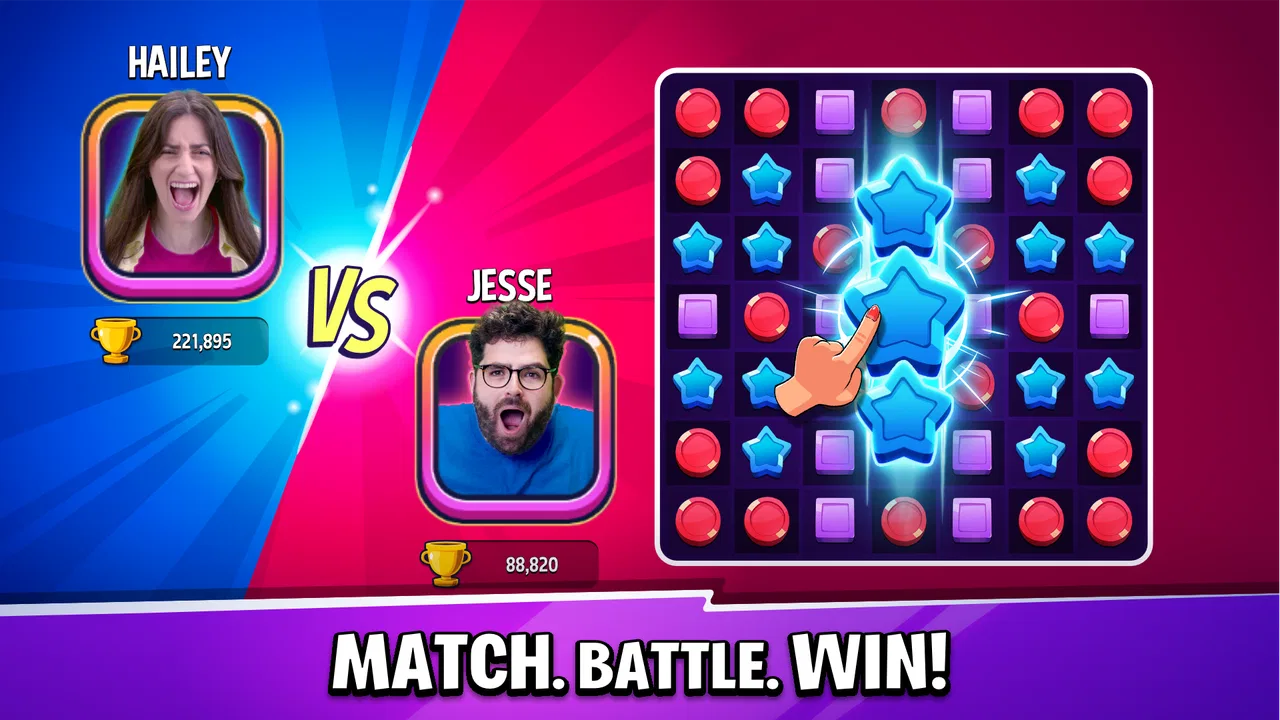
I first approached Match Masters expecting a familiar match-three game, but its competitive format changes the way I play. Candivore’s casual game is built around short puzzle rounds against other players, with real-time multiplayer battles adding pressure that a solo puzzle board usually does not have. It is free to start, rated for Everyone, and available on devices running Android 6.0 or later, so it is easy to try without making a large commitment.
After spending time with it, my impression is that the game works best as a quick competitive distraction rather than a relaxing puzzle experience. The board is simple to understand, yet each move matters because I am not only trying to improve my own score. I am also looking for ways to create stronger opportunities while limiting what the opponent can use. That small shift makes ordinary matching feel more deliberate.
How the current game feels to play
The basic appeal is immediate: I look for matching pieces, clear them, and try to turn the resulting board into a better position. The difference is that another player is involved, so a move can have several purposes. It may increase my score, create a useful setup for the next turn, or remove an opportunity that would otherwise help the opponent.
You May Also Like

 Blood Strike: 2.5 Anniversary
Blood Strike’s Loadouts Turn Every Drop Into a Tactical Gamble
A close look at Blood Strike’s custom loadouts: how fast access to signature weapons reshapes its battle royale rhythm, rewards preparation, and narrows the gap between fights.

 Pandora - Music & Podcasts
Pandora’s Music Is Easy to Start, but Harder to Recover
Pandora’s strength is its low-effort path from a seed to a station. Its weak spot is how much confidence it asks you to place in connection, setup, and quiet recovery.

 8 Ball Pool
 Is Built on Rivalries, Rematches, and Routine
A close look at the rivalries, rematches, shared routines, and unanswered safety questions that turn a quick pool match into a persistent mobile community.

 Samsung Music
’s Quiet Strength Is Playing What You Already Own
Its reach comes less from spectacle than from dependable access to a personal library. That simplicity is both the app’s strongest retention engine and its ceiling.

 AccuWeather: Weather Radar
AccuWeather Review: A Quick, Clear Forecast for Everyday Decisions
For everyday plans, the best forecast is the one you can understand quickly. AccuWeather makes rain timing, radar, and local conditions easy to act on, with a few trade-offs.

 Hill Climb Racing
Why Hill Climb Racing Still Turns Crashes Into One More Run
A tiny car, a bumpy hill and one more upgrade: Hill Climb Racing keeps resurfacing because its simple chaos makes every near-miss feel personal.
More From Our News Desk
View All News


That makes the opening moments of a match more important than they first appear. I do not always benefit from making the biggest visible match. Sometimes the better choice is to prepare the board, preserve a useful color, or avoid giving the other side an easy chain. This is one of the first non-obvious lessons I found: the best move is not always the move with the largest immediate reward.
The real-time format also gives each round a different rhythm from traditional offline match-three games. In a solo title, I can pause to study the board or play without any sense of urgency. Here, the presence of an opponent makes hesitation feel costly, even when the puzzle itself is familiar. That tension is the main reason I kept returning.
At the same time, this is not the right choice for every puzzle fan. If I want a quiet game that I can play entirely at my own pace, a conventional single-player match-three title is a better fit. Match Masters is more appealing when I want a compact contest and enjoy the feeling that another person is responding to my decisions.
A useful game for short breaks
The structure suits everyday gaps in my schedule. I can open it while waiting for an appointment, during a short commute as a passenger, or when I have a few minutes between tasks. The competitive format gives those brief sessions a clear purpose: I enter a match, make decisions, and finish with a result rather than wandering through a large map or story.
A realistic example is a lunch break. I might have enough time for a couple of rounds but not enough attention for a long role-playing session. The game gives me something active to focus on, and the puzzle rules are familiar enough that I do not need a lengthy tutorial before starting. The trade-off is that a competitive round is not necessarily as calming as a solo game, especially after a close loss.
I also found that the game rewards watching the board instead of tapping automatically. When several matches are available, I try to inspect the likely follow-up before committing. A move that looks strong now may leave awkward pieces behind, while a less obvious match can open a better sequence. This makes the experience more thoughtful than the bright, casual presentation initially suggests.
What the competitive design changes
In many match-three games, progress is mainly about clearing a level or meeting a target. Here, I have to think about relative advantage. A move can be valuable because it improves my position and because it prevents the opponent from gaining momentum. That creates a useful layer of defensive thinking without turning the game into a complicated strategy title.
The strongest sessions are the ones where I stop treating every turn as an isolated puzzle. I watch for patterns, consider what the next board may offer, and avoid spending a good opportunity simply because it is visible first. This is especially useful for new players who feel that matches are decided by luck. Luck can influence the board, but careful scanning gives me more control over the choices available.
There is also a psychological difference between playing against a person and playing against a predictable computer opponent. A real-time match feels more immediate, and a sudden reversal is more memorable. That energy helps the game stand out from standard casual puzzle apps, although it can also make repeated losses feel more personal than they would in a solo campaign.
Progress, spending, and the free starting point
The game is free to download and play, which makes trying it straightforward. It includes optional in-app purchases ranging from $0.49 to $99.99 per item. I would approach those purchases carefully. The low entry price is convenient, but the upper end is substantial enough that anyone who tends to buy impulsively should decide on a limit before playing regularly.
My advice is to treat purchases as optional extras rather than part of the basic decision to install. First, I would play enough to decide whether the real-time competition is genuinely enjoyable. If the core matches do not hold my attention, spending will not fix that. If they do, setting a personal budget keeps the game in the casual category instead of letting it become an unplanned expense.
This is another important trade-off compared with ordinary free match-three games. A solo alternative may feel easier to control because I can stop whenever I want and do not have another player’s momentum affecting the session. Match Masters offers more excitement, but that excitement can encourage “one more match” behavior, particularly after a narrow defeat.
How the game has developed
The game was released on June 8, 2017, and its current version is 5.405. That combination tells me this is an established title rather than a new experiment still searching for its identity. A long-running version history can be reassuring for players who prefer games with an existing audience and continued maintenance, although it does not automatically mean every update will feel significant to every user.
The current state is also reflected in its broad reach: it has passed 50 million installs, with an average rating of 4.8 from around 2.5 million ratings and roughly 188 thousand written reviews. Those figures suggest that the game has attracted a large and active audience. I would still treat popularity as a starting signal, not a guarantee that its competitive style will suit me personally.
For someone returning after a long break, the version number is useful context. I would expect the present experience to be more mature than the early release, but I would not assume that every familiar detail remains unchanged. The sensible approach is to revisit the core match flow first, then decide whether the current pace, competition, and spending options fit the way I want to play now.
Existing users should also remember that a mature competitive game can feel different as the community grows. More opponents can mean faster matchmaking and a wider range of play styles, but it can also make early matches feel less forgiving. A returning player may need a short adjustment period rather than judging the current experience from the first round alone.
Who will enjoy it most
I would recommend it to players who already like match-three mechanics but want more tension than a standard level-based game provides. It is especially suitable for people who enjoy short contests, quick decisions, and learning through repeated rounds. The Everyone rating also makes it broadly approachable from an age-classification standpoint, while the competitive format still requires a degree of patience and self-control.
It is less suitable for someone seeking a story, a large exploration world, or a purely offline pastime. It may also disappoint players who dislike losing because of an unfavorable board or who prefer to analyze every move without time pressure. The game asks me to accept uncertainty and keep playing intelligently even when the position is not ideal.
I would also hesitate to recommend it as a first choice for anyone who wants a completely interruption-friendly game. A solo puzzle can usually be paused with less consequence. In a real-time contest, leaving midway can affect the match and the other player’s experience. That does not make the design bad; it simply means I need to start a round when I can give it my attention.
Practical habits that improve the experience
My first tip is to slow down during the opening scan, even if the board looks obvious. I look for more than one possible match and check whether a move creates a useful continuation. This habit prevents the common mistake of taking the first available match and discovering afterward that a better setup was available.
Second, I try not to judge a round by one turn. A weak-looking move can become valuable if it changes the board in a way that improves the next decision. Conversely, a spectacular clear may leave me with fewer useful options. Thinking one move ahead is more reliable than chasing the most dramatic animation.
Third, I separate learning from winning. When I lose, I ask whether I missed a board pattern, reacted too quickly, or chose a move that helped the opponent. That review makes the next match more useful. It also reduces the temptation to spend immediately after a defeat in the hope of recovering the result.
Finally, I would play in short, intentional sessions. If I notice that I am continuing only because I want to erase a loss, I stop. This is a small but practical way to preserve the casual nature of the game and keep optional purchases from influencing decisions made out of frustration.
Remaining friction and what to watch
The largest limitation is built into the concept: real-time competition is more demanding than a relaxed solo board. The game can be enjoyable when I want energy, but it is not always the best companion for tired evenings or moments when my connection, attention, or patience is limited. Anyone installing it should understand that the multiplayer focus is central, not a minor extra attached to a traditional puzzle game.
The other point I would watch is how the current version continues to serve both newcomers and long-time players. A mature title needs to remain approachable without making experienced users feel that their knowledge no longer matters. For new players, clear onboarding and fair-feeling early matches are important. For returning users, the question is whether the familiar core still feels rewarding after the initial nostalgia fades.
I would also keep an eye on the balance between competition and optional spending. The listed purchase range is wide, so responsible play matters. I prefer to decide in advance whether I am playing only for the matches or whether I am comfortable buying extras. That simple boundary makes it easier to evaluate the game on its actual puzzle design instead of on pressure created by a close result.
Compared with a typical match-three alternative, this game’s strongest advantage is the human-versus-human urgency. Its weakness is the same feature: it offers less calm, less flexibility, and potentially more frustration than a solo puzzle. Choosing between them depends on the moment. When I want a quick contest, Match Masters is the more engaging option. When I want quiet repetition or complete control over my pace, I would choose the simpler alternative.
Overall, I see this as a well-established casual puzzle game with a clear identity. Candivore has taken familiar matching mechanics and made them more involving by placing them inside short competitive encounters. The large audience, strong average rating, and current 5.405 version show that it has sustained interest, but those facts matter less than whether I enjoy playing against another person.
My final recommendation is straightforward: try it if you want match-three gameplay with pressure, quick rounds, and room to improve through observation. Start without spending, learn to look beyond the first available move, and decide whether the competitive rhythm suits you. It is at its best when I treat each round as a small strategic contest, not merely as another casual board to clear.
FAQs for Match Masters
01What is Match Masters and how does it work?
Match Masters is a competitive match-3 puzzle game available on both Android and iOS platforms. Players face off against each other in real-time battles, aiming to score the highest points by matching colorful pieces on a grid. Unique power-ups and boosters can be used to gain an advantage over opponents, making strategy and quick thinking essential.
02Does Match Masters require an internet connection?
Yes, Match Masters requires an active internet connection to play. This is because the game features real-time multiplayer matches where you compete against other players from around the world. A stable connection ensures smooth gameplay and prevents disruptions during matches, which could affect your performance.
03Are there in-app purchases in Match Masters?
Match Masters offers in-app purchases that allow players to buy coins, boosters, and other items to enhance their gaming experience. While these purchases can provide advantages, they are optional, and the game can still be enjoyed without spending money. Players can also earn rewards through gameplay and daily challenges.
04How does the ranking system work in Match Masters?
The ranking system in Match Masters is based on your performance in matches. Winning games earns you trophies, which contribute to your overall rank. As you accumulate more trophies, you can move up the leaderboard and face tougher opponents. Losing matches may result in losing trophies, so consistent performance is key.
05Is Match Masters suitable for all ages?
Match Masters is designed to be a fun and engaging game for players of all ages. However, parental guidance is recommended for younger players, especially due to the presence of in-app purchases and online interactions. The game does not feature any inappropriate content, making it a family-friendly choice.
Pros
- Engaging multiplayer matches.
- Variety of power-ups available.
- Regular updates with new features.
- User-friendly interface.
- Cross-platform compatibility.
Cons
- In-app purchases can be pricey.
- Requires a stable internet connection.
- Occasional matchmaking delays.
- Limited offline play options.
- Ads can be intrusive.

Match Masters
Gallery